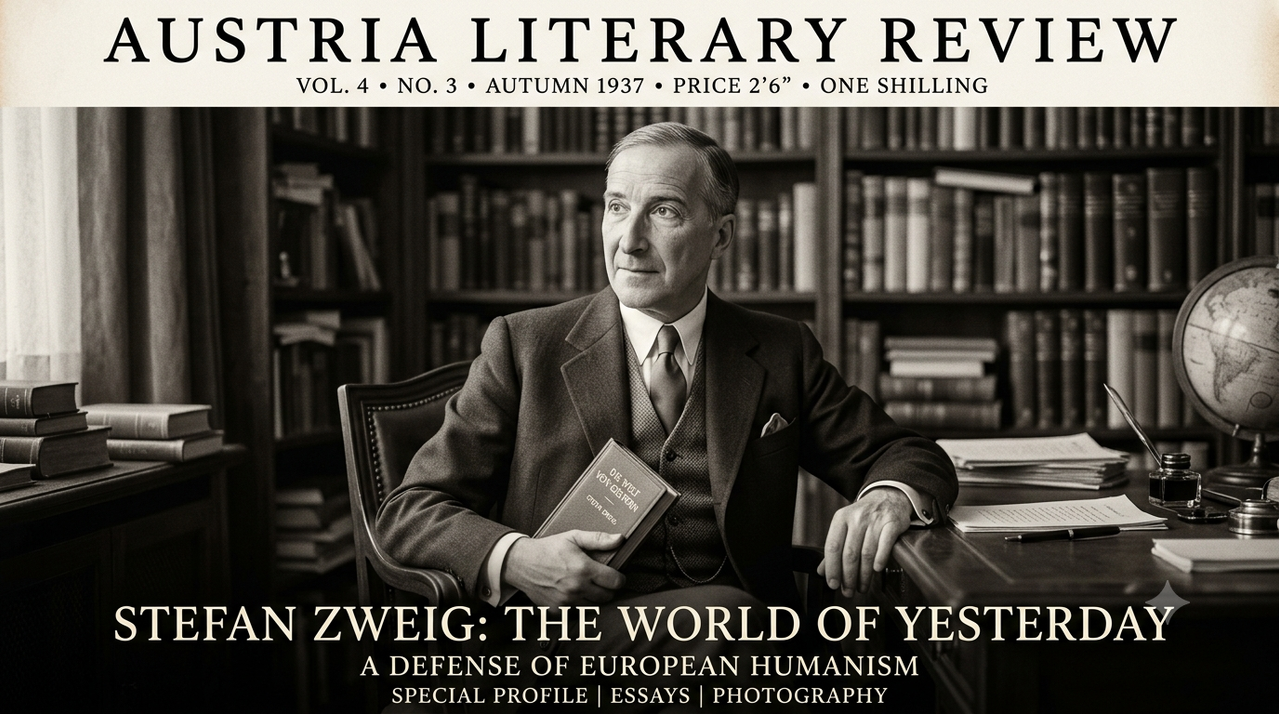
1. Executive Summary and Research Overview
Stefan Zweig (born November 28, 1881, in Vienna, Austro-Hungarian Empire; died February 23, 1942, in Petrópolis, Brazil) stands as a monumental figure in 20th-century world literature. A versatile man of letters, Zweig achieved global fame across multiple genres, including psychological novellas, intuitive historical biographies, cultural essays, and anti-war theatrical dramas.
Born into a prosperous secular Jewish bourgeois family in imperial Vienna, Zweig grew up surrounded by the golden age of fin-de-siècle European arts. When World War I shattered the political stability of his youth, Zweig transformed into a committed pacifist and cultural ambassador. Throughout his career, he passionately advocated for European cultural unity, intellectual exchange beyond national borders, and the preservation of individual liberty against political fanaticism.
2. In-Depth Biography: From Viennese Golden Age to Petrópolis Exile
Early Life and Viennese High Culture
Raised in the opulent cultural capital of the Habsburg Empire, Zweig earned his doctorate in philosophy from the University of Vienna in 1904. His literary career began with early poetry collections such as Silberne Saiten (1901). During his formative years, Zweig traveled extensively across Europe and translated the works of French symbolist poets—including Paul Verlaine, Charles Baudelaire, and Émile Verhaeren—into German, cultivating his refined aesthetic sensibility.
World War I and the Adoption of Radical Pacifism
At the outbreak of World War I in 1914, Zweig was assigned to work in the Austrian War Archives (Kriegsarchiv) in Vienna. Witnessing firsthand the tragic devastation of war and the rise of blind nationalism transformed his worldview. Joining forces with fellow pacifist writers like Romain Rolland, Zweig relocated to neutral Switzerland to stage his anti-war drama Jeremiah (1917), establishing himself as a key voice in the European anti-war movement.
The Golden Salzburg Years (1919–1934)
Following the collapse of the Austro-Hungarian Empire, Zweig settled at Villa Kapuzinerberg in Salzburg with his first wife, Friderike. During the 1920s and early 1930s, his home became an intellectual sanctuary visited by Europe's leading thinkers, including Sigmund Freud, Arthur Schnitzler, Richard Strauss, Arturo Toscanini, and Thomas Mann. In this highly creative period, Zweig published his internationally bestselling biographies Joseph Fouché (1929) and Marie Antoinette (1932), as well as his iconic psychological novellas.
Nazi Persecution, Global Exile, and Tragic End
The rise of Nazism in Germany in 1933 systematically dismantled Zweig's world. His books were burned by Nazi authorities in 1933 due to his Jewish heritage and pacifist stance. Following a police raid on his Salzburg residence in early 1934, Zweig fled Austria for London and Bath, obtaining British naturalization. As World War II engulfed Europe, he moved to New York in 1940 and finally to Petrópolis, Brazil, in 1941. Deeply traumatized by the destruction of European civilization, Zweig and his second wife, Lotte Altmann, tragically died by joint suicide on February 23, 1942.
3. Chronological Life Timeline and Key Historical Milestones
| Year | Biographical Event | Literary Significance & Historical Impact |
|---|---|---|
| 1881 | Born in Vienna on November 28. | Raised in the "Golden Age of Security" of the Habsburg Empire. |
| 1901 | Publishes first poetry collection, Silberne Saiten. | Official literary debut within Viennese cultural circles. |
| 1904 | Earns Ph.D. in Philosophy from University of Vienna. | Begins international travels across Europe, India, and North America. |
| 1917 | Stages anti-war play Jeremiah in neutral Switzerland. | Establishes international reputation as a leading pacifist voice. |
| 1919 | Establishes residence at Villa Kapuzinerberg, Salzburg. | Transforms Salzburg home into a hub for European intellectuals. |
| 1927 | Publishes historical miniatures, Sternstunden der Menschheit. | Becomes one of the most widely read books in interwar Europe. |
| 1933 | Zweig's literary works burned by Nazi regime in Germany. | Beginning of systematic Nazi ban on Jewish-German writers. |
| 1934 | Emigrates to England following Salzburg home search. | Enters lifelong exile; publishes biography Erasmus of Rotterdam. |
| 1941 | Relocates to Petrópolis, Brazil; finishes Schachnovelle. | Completes monumental autobiography Die Welt von Gestern. |
| 1942 | Passes away in Petrópolis on February 23 alongside Lotte Altmann. | Tragic death shocks the global literary community. |
4. Major Works Catalog and Genre Classification
Stefan Zweig was a prolific author whose literary output spanned fiction, history, and translated poetry. The table below outlines his most celebrated works:
| Original Title (German) | English Translation | Year | Genre | Core Themes & Analytical Focus |
|---|---|---|---|---|
| Amok | Amok / Passion and Compulsion | 1921 | Novella | Extreme psychological obsession, duty, and colonial isolation. |
| Der Brief einer Unbekannten | Letter from an Unknown Woman | 1922 | Novella | Unrequited love, secret obsession, and female self-sacrifice. |
| Verwirrung der Gefühle | Confusion of Feelings | 1925 | Novella | Repressed desires, academic mentorship, and emotional duality. |
| Sternstunden der Menschheit | Decisive Moments in History / Tide of Fortune | 1927 | Historical Essays | Dramatic historical crossroads that shaped human destiny. |
| Joseph Fouché | Joseph Fouché: Portrait of a Politician | 1929 | Biography | Tactical political opportunism and power behind the scenes. |
| Marie Antoinette | Marie Antoinette: Portrait of an Ordinary Woman | 1932 | Biography | Psychoanalytic deconstruction of royal tragedy during revolution. |
| Ungeduld des Herzens | Beware of Pity | 1939 | Novel | The destructive nature of false pity and moral weakness. |
| Schachnovelle | The Royal Game / Chess Story | 1941 | Novella | Gestapo psychological isolation, chess monomania, and fascism. |
| Die Welt von Gestern | The World of Yesterday | 1942 | Memoir | Elegy for lost European civilization and human freedom. |
5. Analysis of Core Themes, Monomania, and Freud's Influence
Psychoanalysis and Character Construction
The teachings of Sigmund Freud deeply informed Zweig's narrative methodology. Zweig maintained a lifelong correspondence with Freud, acknowledging that psychoanalysis gave writers the courage to explore the subconscious mind with unprecedented clarity. Zweig's protagonists are frequently intellectuals driven into crisis by "monomania"—a state of singular, uncontrolled psychological fixation that overpowers reason and social conventions.
Isolation and Fascist Oppression in Schachnovelle
In his posthumous masterpiece Schachnovelle (Chess Story), Zweig explores the psychological effects of Nazi interrogation techniques. The protagonist, Dr. B, survives months of total solitary confinement in a Gestapo hotel room by stealing a book of grandmaster chess games. To keep his sanity, Dr. B splits his personality to play thousands of mental chess matches against himself. However, this mental coping mechanism metastasizes into "chess poisoning" (monomania), serving as a powerful allegory for the clash between cultured European intellect and cold, totalitarian cruelty.
The Defense of Individual Liberty
Across all his historical writings, Zweig consistently prioritized the sovereignty of the individual conscience against political fanaticism and mass hysteria. This theme runs through his biographical studies of spiritual independence—such as Erasmus of Rotterdam and Castellio against Calvin—where he champions quiet humanists against dogmatic tyrants.
6. Impact on European Literature and Modern Critical Reception
During the 1920s and 1930s, Stefan Zweig was widely recognized as one of the most popular and frequently translated living authors globally. His smooth narrative style, vivid psychological portrayals, and accessible prose brought him massive international readership across continental Europe, North America, and South America.
Critical evaluation of his work has historically been divided. While readers and contemporaries celebrated his humanism, narrative pacing, and emotional depth, some mid-to-late 20th-century critics dismissed his style as overly sentimental. Modern German translator Michael Hofmann launched a famous critique characterizing Zweig's writing as lightweight. Nevertheless, major reissuing initiatives by Pushkin Press and NYRB Classics triggered a widespread critical revival. Furthermore, acclaimed filmmaker Wes Anderson explicitly cited Zweig's memoirs and fiction as the primary inspiration behind his Academy Award-winning film The Grand Budapest Hotel (2014).
7. Featured Essay: The Tragedy of Yesterday's World and Humanist Exile
When Stefan Zweig mailed the finished manuscript of Die Welt von Gestern (The World of Yesterday) to his Swedish publisher in February 1942, he understood that he had completed his final duty to history. The book was not merely a personal autobiography of a Viennese intellectual, but a monument dedicated to a vanished European civilization destroyed by two world wars.
Zweig famously characterized the era of his youth in late 19th-century Austria as the "Golden Age of Security" (Guldene Zeitalter der Sicherheit). It was a period when liberal institutions, artistic achievement, and social stability seemed permanent. However, that stability was shattered by the unexpected outbreak of World War I in 1914 and the subsequent rise of aggressive totalitarian regimes across Europe during the interwar years.
Exile stripped Zweig of his home, his personal library, and his native German-speaking audience. For an author whose entire life was built upon European cultural synthesis, living as an expatriate in South America highlighted his existential displacement. His final suicide note in Petrópolis expressed gratitude to Brazil for its warm hospitality, while acknowledging that rebuilding a life from its foundations required strength that a 60-year-old wanderer, uprooted from his spiritual home, no longer possessed. Today, Zweig's writings serve as a timeless reminder of the fragility of civilization, the dangers of political extremism, and the enduring value of human tolerance.
8. Key Masterpiece Quotations and Context
"Whoever has once tasted the spiritual freedom and cultural dignity of Europe can never be cured of his longing for it."
"True pity is not that sentimental surge of emotion, but the creative determination to stand alongside another person until their suffering is brought to an end."
"There is nothing on earth more terrifying to the human mind than absolute isolation without an object, a void where thoughts turn endlessly upon themselves."
9. Frequently Asked Questions (FAQ)
What is Stefan Zweig's most famous book?
Stefan Zweig's most famous works include his psychological novella Schachnovelle (The Royal Game or Chess Story), his European memoir Die Welt von Gestern (The World of Yesterday), and acclaimed biographies such as Marie Antoinette and Joseph Fouché.
Why did Stefan Zweig commit suicide in Brazil in 1942?
Stefan Zweig and his second wife, Lotte Altmann, committed suicide in Petrópolis, Brazil due to deep despair over the destruction of European culture during World War II, the expansion of Nazism, and the trauma of lifelong exile without a homeland.
How did Sigmund Freud influence Stefan Zweig's writing?
Zweig was a close friend and correspondent of Sigmund Freud. Freud's psychoanalytic methods directly inspired Zweig's detailed psychological character studies, particularly his exploration of subconscious fixations, compulsions, and monomania.
Where are Stefan Zweig's original manuscripts and archives preserved?
Major archival collections are held at the Literaturarchiv Salzburg (University of Salzburg, Austria), the Daniel A. Reed Library at SUNY Fredonia (USA), the National Library of Israel, and the British Library. These items are digitized and searchable via Stefan Zweig Digital.
10. Academic References and Digital Repositories
The research and documentation on this portal are drawn from verified primary archives and academic databases:
- Stefan Zweig Digital (SZD) — Literaturarchiv Salzburg, Paris Lodron Universität Salzburg. Online Portal: stefanzweig.digital
- Stefan Zweig Collection — Daniel A. Reed Library, State University of New York (SUNY) at Fredonia.
- Stefan Zweig Centre Salzburg — Edmundsburg Research Center, Salzburg, Austria.
- International Stefan Zweig Society (ISZS) — Global Academic Research Network.
- Mittermayer, Manfred & Zangerl, Lina Maria. (2018). Stefan Zweig Digital: Reconstructing Literary Estate in the Humanities Era. Salzburg.
Join the Stefan Zweig Academic Network
Subscribe to receive regular updates on newly digitized manuscripts, critical essays, and international literary seminars.